
Open any marketing blog right now and you'll find the same article written fifty different ways: "AI is revolutionizing ecommerce." It's true. But the version most people are selling — paste your product description into a chatbot and watch the sales roll in — is not what's actually happening.
What's actually happening is more interesting, more technical, and more useful. A small number of brands and agencies are building custom AI infrastructure that changes how campaigns get researched, created, tested, and measured. Not incrementally. Structurally.
The problem is that "AI marketing" has become meaningless. Every SaaS tool, every agency, every freelancer on Upwork now claims to be AI-powered. Most of them mean they have a ChatGPT wrapper. Some of them mean they use Jasper or Copy.ai. A few of them have actually built something.
This article is about what AI ecommerce marketing looks like when it's real — not the pitch deck version, but the version that changes how money gets spent and measured. We'll cover the specific areas where AI is creating a genuine advantage for ecommerce brands, what smart companies are doing differently, and how to tell the difference between AI marketing and "AI" marketing.
The AI Washing Problem
Let's start with what most "AI marketing" actually looks like today.
A brand signs up for an AI copywriting tool. They type in their product name, select a template, and get five headlines. The headlines are grammatically correct and completely generic. They could apply to any product in the category. The brand runs them anyway because they're fast and cheap.
A marketing agency adds "AI-powered" to their website. Behind the scenes, their process hasn't changed. They still build campaigns manually in Ads Manager. They still use Canva for creative. They still copy numbers from platform dashboards into Google Sheets for reporting. The "AI" part means someone on the team uses ChatGPT to draft client emails.
This isn't a criticism. These tools are useful at the margin. But calling it AI marketing is like calling a calculator-equipped accountant a "fintech firm." The tool exists in the workflow, but it hasn't changed the workflow.
Real AI marketing looks fundamentally different. The infrastructure changes. The speed changes. The depth of research changes. The volume of testing changes. The accuracy of measurement changes.
Here's what that looks like in practice across the five areas that matter most for ecommerce brands.
1. Campaign Management: Custom Infrastructure vs. Platform UIs
The standard way to build a Meta or Google campaign: log into the platform, click through a series of forms, set your targeting, write your ad copy in text boxes, upload creative one asset at a time, set budgets, review, publish. For a single campaign, that's fine. For a multi-product brand running tests across audiences, it's painfully slow and error-prone.
The AI-native approach: campaigns defined as structured briefs — JSON files that specify targeting, copy, creative assets, budgets, and objectives. A command-line tool reads the brief, validates everything, shows a preview, and pushes the campaign to the platform's API. Ads start paused by default. Every change is logged. Every push gets a dry-run first.
This isn't theoretical. We built a Meta Ads CLI that handles campaign creation, ad set management, creative uploads, and performance reads — all from the terminal. The same approach applies to Google Ads through a separate campaign builder with keyword discovery, RSA generation, and structured deployment baked in.
Why does this matter for brands? Three reasons.
Speed. A campaign that takes a media buyer two hours to build in Ads Manager takes fifteen minutes from a brief. That's not exaggeration — it's the difference between clicking through forms and running a command.
Consistency. When campaigns are defined as structured data, there's no "I forgot to set the attribution window" or "I accidentally left broad targeting on." The tool enforces your standards automatically.
Scale. When launching creative tests means pushing a new brief instead of rebuilding campaigns manually, you test more. More tests means faster learning. Faster learning means better performance.
The takeaway: If your agency or in-house team is still building every campaign by hand through platform UIs, they're spending hours on work that machines handle better. The strategic decisions — what to test, who to target, when to scale — those still need human judgment. The execution shouldn't.
2. Creative Intelligence: Research-Driven vs. Template-Driven
This is where the gap between real AI marketing and AI-washed marketing is widest.
The template approach: pick a Canva template, swap in your product photo, add a headline from a swipe file, publish. The "AI-enhanced" version: use a tool to generate five headline variations and pick the one that sounds best.
The research-driven approach is a pipeline, not a single tool. Here's what it looks like.
Market research comes first. AI pulls and analyzes customer voice data from reviews, Reddit threads, forums, and social media. Not just sentiment analysis — structured extraction of pain points, desires, language patterns, and purchase triggers. It maps competitors' positioning, offers, and creative patterns. It assesses market sophistication on the Schwartz awareness scale. The output is a research document that would take a human analyst a week to produce.
Personas are built from research, not assumptions. Instead of "Meet Marketing Mary, she's 35 and likes yoga," you get personas with layered pain points (surface to emotional), cognitive bias susceptibility profiles, exact language patterns extracted from real customer data, and visual specs for image generation. These are functional documents that directly inform creative decisions.
Creative flows from personas. Copy isn't generated from templates — it's generated from behavioral science frameworks matched to specific personas at specific awareness levels. When we write ad copy for one of our ecommerce clients, the system considers which cognitive biases are most effective for the target segment, which awareness level they're at, and which copywriting framework (PAS, BAB, Hook-Story-Offer) best fits the situation.
Image generation is psychology-driven. AI-generated ad images aren't random lifestyle shots. They're designed to trigger specific emotional responses in specific audience segments, informed by the research that started the whole pipeline.
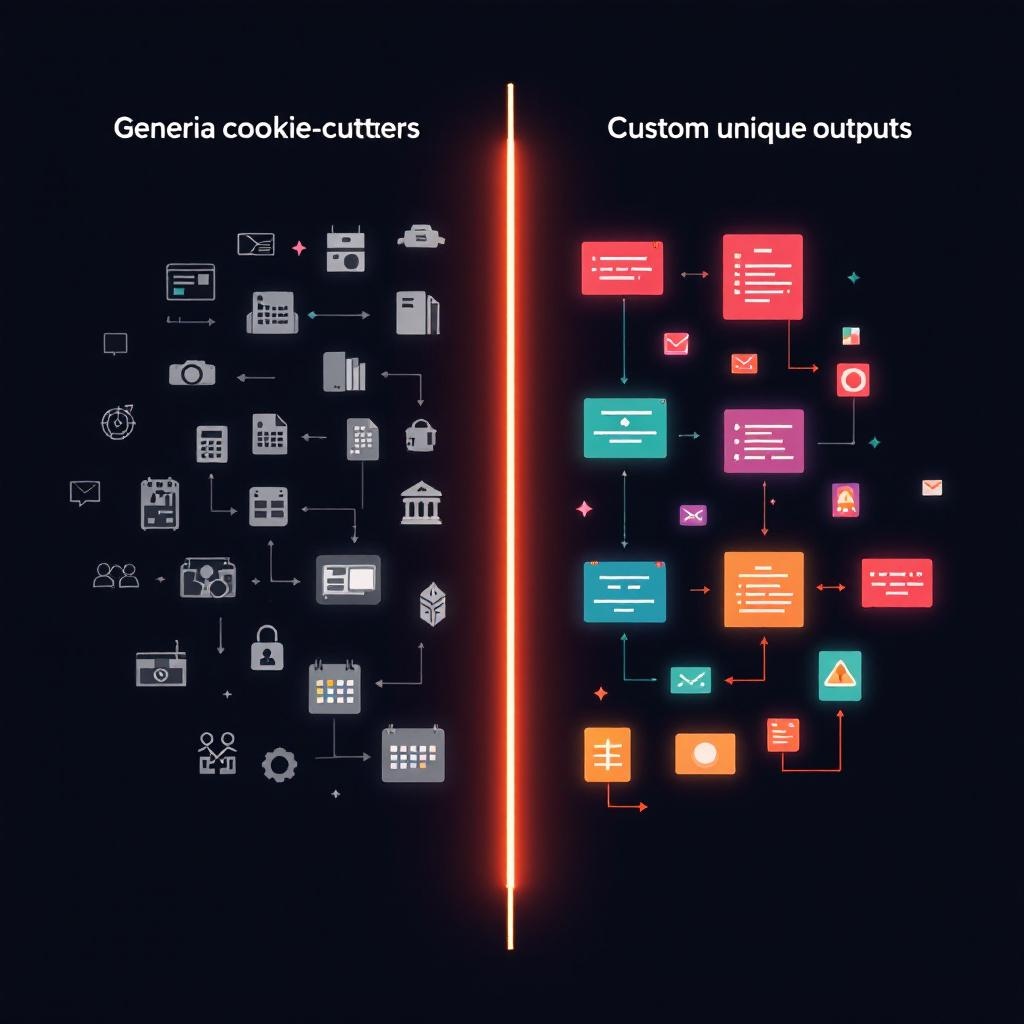
The takeaway: The difference between AI-generated creative and AI-informed creative is enormous. The first gives you fast mediocrity. The second gives you research depth that would be financially impossible to replicate manually, translated into creative decisions that are specific to your brand, your market, and your customers.
3. Landing Pages: Custom-Built vs. Drag-and-Drop
Most ecommerce brands send paid traffic to one of three places: their homepage (bad), a product page (okay), or a landing page built in Unbounce or Instapage (better). The problem with the page builders isn't that they're bad tools. It's that they optimize for ease of creation, not conversion.
A page builder gives you drag-and-drop convenience. But convenience comes with constraints: template-driven layouts, shared hosting that affects load speed, limited testing capabilities, and monthly subscription costs that scale with traffic.
What we built instead: a component-based landing page system that generates self-contained HTML files. No CMS. No page builder subscription. The pages load fast because there's no bloat. They're deployed to GitHub Pages or any static host. And they're backed by a split testing dashboard that makes A/B testing frictionless.
Here's the part that changes the game for ecommerce brands: because the pages are built from a component library (not dragged-and-dropped from templates), we can match the ad creative exactly. The headline on the landing page echoes the hook in the ad. The visual treatment matches the creative. The offer is consistent from impression to purchase.
Message match sounds basic. In practice, it's remarkably rare. Most brands run ads with one message and land users on a generic product page with a different message. Every mismatch is a leak in the funnel.
Our split testing infrastructure makes this measurable. We define tests through a browser dashboard — headline variants, CTA copy, hero images, layout changes — and the changes take effect on live pages immediately. No code deployment. No developer tickets. Visitors are assigned to variants automatically, and statistical significance is calculated in real-time.
For one of our ecommerce clients, this meant we could test a new landing page headline in under a minute. Over the course of a month, we ran more headline and CTA tests than most brands run in a year. The cumulative effect on conversion rate was significant — not because any single test was a breakthrough, but because continuous testing compounds.
The takeaway: Your landing page is where money either converts or leaks. If your testing cadence is quarterly (or nonexistent), you're leaving conversions on the table. The right infrastructure makes testing a weekly habit instead of a quarterly project.
4. Reporting and Attribution: Real Numbers vs. Platform Numbers
This one is personal for us, because the gap between platform-reported performance and reality is where brands lose the most money.
Here's the situation. Meta says your ROAS is 5.0. Google says your ROAS is 4.0. You add them up and figure you're generating $9 in revenue for every $1 in ad spend. Then you check your Shopify dashboard and realize your total revenue doesn't support those numbers. Not even close.
This isn't a bug. It's by design. Both platforms use attribution models that favor their own ads. View-through conversions, broad attribution windows, and cross-platform overlap mean that both Meta and Google take credit for the same sale. If you add up all the revenue claimed by every platform, you'll regularly exceed your actual revenue by 30-50%.
We wrote a detailed article on true ROAS calculation that breaks this down technically. But the practical implication is straightforward: if you're making budget decisions based on platform-reported ROAS, you're probably misallocating money.
Our approach: custom reporting tools that pull from your actual revenue source — Shopify, Amazon, your payment processor — and match orders to ad spend by UTM source. One command generates a consolidated report across all channels with blended ROAS calculated from first-party data.
For brands running on both Meta and Google (which is most of our clients), this is transformative. Instead of looking at two separate dashboards with inflated numbers, they see one report with honest numbers. Decisions get better immediately because the inputs are accurate.
We also built automated weekly reports that deliver performance summaries without anyone logging into a dashboard. The report runs, the data pulls, the summary generates, and the client gets a clear picture of what happened — all in a single markdown document that takes thirty seconds to read.
The takeaway: Attribution in ecommerce marketing is broken by default. The platforms that charge you for ads are the same platforms telling you how well those ads performed. If you don't have an independent measurement system, you don't have real numbers. AI makes building that system practical — but the harder part is admitting that your "5x ROAS" might actually be a 2.5x.
5. SEO and Content: Brand-Voice Generation vs. Generic AI Content
AI-generated content has a reputation problem, and it's mostly deserved. The first wave of AI blog posts — thin, generic, obviously machine-written — gave brands a legitimate reason to be skeptical. Google's response was equally clear: they don't penalize AI content, but they penalize unhelpful content. Most AI-generated SEO content is unhelpful.
The difference between generic AI content and effective AI content comes down to context injection. When a language model generates a blog post from a bare keyword, it produces the average of everything it's seen on that topic. It's accurate, it's bland, and it reads like every other AI article.
When you inject specific context — brand voice guidelines, competitor positioning rules, product knowledge, customer language patterns, strategic keyword targets — the output changes qualitatively. It still needs human editing. But the starting point is a draft that sounds like the brand and addresses the actual questions their customers are asking.
Our SEO platform handles this end-to-end. Keyword discovery pulls from search data APIs. An AI classification layer processes hundreds of keywords in batches, determining relevance, intent, and realistic ranking difficulty for each one. Keywords get clustered into topic groups. Content briefs are generated with target keywords, related terms, and competitive context. And when the content is written, the client's brand voice, positioning, and competitor framing rules are injected directly into the generation prompt.
The result is content that requires human review and editing — we're not suggesting you publish unedited AI output — but that starts from a much higher baseline than either a blank page or a generic AI draft.
The takeaway: AI content without brand context is commodity content. The value isn't in the generation — that's cheap and fast for everyone now. The value is in the research, classification, and context injection that happens before generation, and the editorial judgment that happens after.
What Smart Brands Should Look For
If you're evaluating agencies, tools, or in-house capabilities for AI-powered ecommerce marketing, here's a practical framework.
Red flags:
- "AI-powered" with no explanation of what that means technically
- Generic outputs that could apply to any brand in your category
- Reporting that only shows platform-reported metrics
- No testing infrastructure or a testing cadence of "when we get around to it"
- Creative process that starts with templates rather than research
- Same SaaS stack as every other agency (Canva, Jasper, Unbounce, Hootsuite)
Green flags:
- Custom tools built for specific workflows, not generic SaaS dependencies
- Research depth that's specific to your brand, market, and customers
- Attribution measured from first-party data, not platform dashboards
- Continuous testing infrastructure with documented results
- Creative informed by competitive intelligence and customer voice data
- Transparent about what AI handles and what requires human judgment
The question isn't "does this agency use AI?" Everyone uses AI in 2026. The question is "does this agency have AI infrastructure that produces materially different results than what I could get from off-the-shelf tools?"
According to Retool's 2026 survey, 35% of enterprises are actively replacing SaaS tools with custom-built alternatives. That trend isn't slowing down. The brands and agencies investing in proprietary infrastructure now will have compounding advantages over those locked into the same shared platforms.
The Real Shift
The honest version of "AI is changing ecommerce marketing" isn't that AI replaces marketers or that pressing a button generates a profitable campaign. It's that AI changes the economics of infrastructure.
Things that used to require a team of ten — research, creative, copy, landing pages, reporting, testing — can now be handled by a smaller team with better tools. Things that used to require $2,000/month in SaaS subscriptions can be replaced by custom tools running on API calls that cost pennies. Things that used to take two weeks can happen in two days.
That doesn't make the work easier. It makes the work different. The competitive advantage shifts from operational capacity (how many people can you throw at this) to strategic quality (how good are your decisions, and how fast can you act on them).
For ecommerce brands, this means the agencies and teams that will win over the next few years aren't necessarily the biggest or the most expensive. They're the ones with the best infrastructure — custom tools, integrated pipelines, and the marketing experience to know what to build and why.
Let's Talk
We built Clare Digital around this approach: custom AI infrastructure, honest measurement, and the marketing experience to make it all work for real ecommerce brands.
If you're running a DTC brand and want to understand what AI-native marketing could look like for your specific situation, book a 30-minute call. No pitch deck. We'll look at your current setup and tell you where the biggest opportunities are.