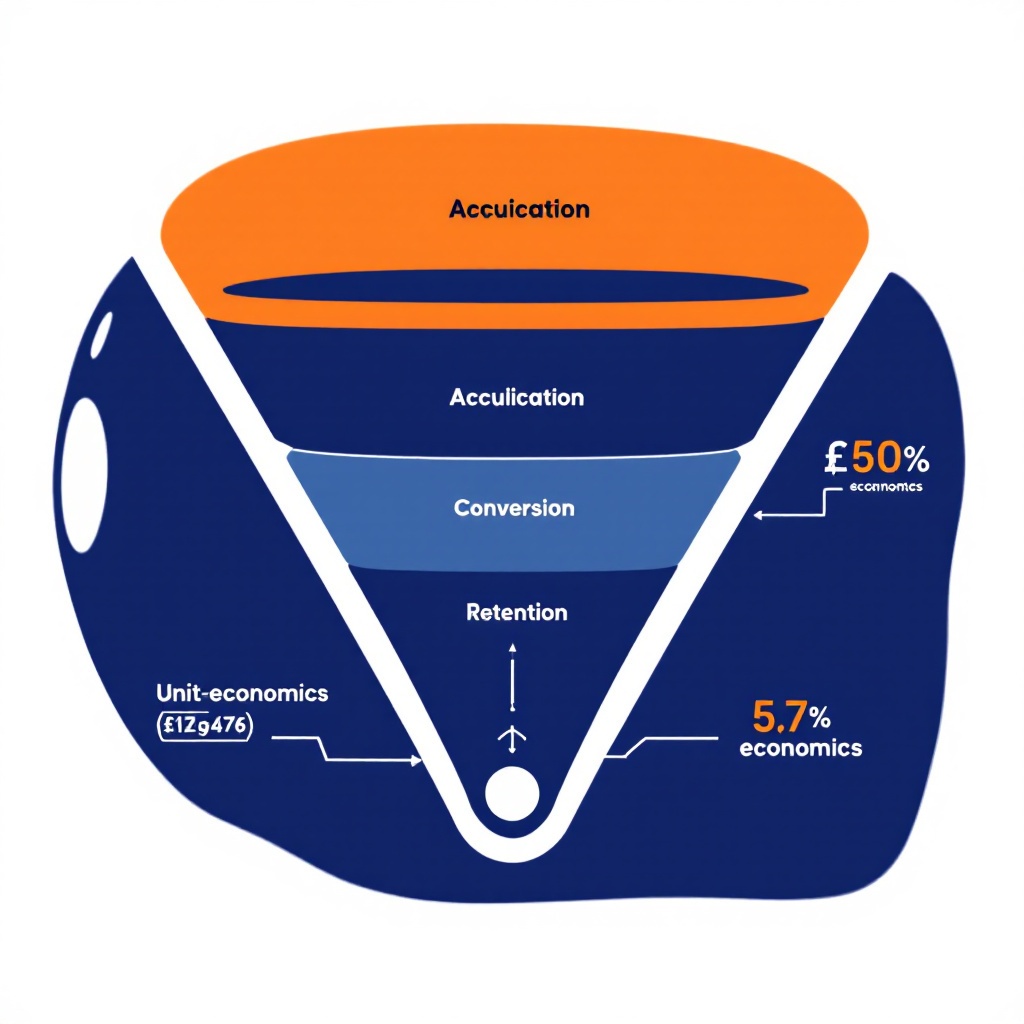
Most of the time when a brand asks me to look at their DTC marketing strategy, what they hand me is a channel list. We're on Meta, we're testing TikTok, we want to do more email, somebody mentioned we should be on Google. That's not a strategy. That's an inventory of where the money is going.
A DTC marketing strategy is a decision about how a stranger becomes a customer, how much that's allowed to cost, and what happens after the first order. The channels are just where you execute it. I run a marketing agency that works almost entirely with direct-to-consumer brands, and the order you make those decisions in matters more than any single channel choice.
Here's the order I build one in.
A DTC Marketing Strategy Starts With the Math, Not the Channels
Before I open Ads Manager, I want three numbers: what it costs to acquire a customer, what that customer is worth over time, and what the brand can afford to spend to break even. If those three numbers aren't defined, every downstream decision is a guess.
This is where most DTC marketing strategies fall apart. A brand picks a target ROAS out of the air — "we need 3x" — without checking whether 3x on the first order is even survivable given their margin, or whether 1.5x is fine because the second order pays for the first.
The numbers I anchor on:
- CAC — the fully-loaded cost to acquire one customer, ad spend plus the management and creative cost behind it.
- LTV — what that customer spends over their lifetime, not just on order one. For most DTC brands the profit lives in orders two through five.
- MER — marketing efficiency ratio, total revenue divided by total marketing spend. It's the number that doesn't lie when platform attribution does.
If you're fuzzy on the difference between some of these, I wrote separate pieces on CAC vs CPA and what MER actually measures. The point here is that the strategy is downstream of the economics. You don't pick a budget and hope. You pick a CAC ceiling the LTV can support, then build acquisition to hit it.
Acquisition: Match the Channel to How People Buy the Product
Once the math sets the ceiling, acquisition is the question of where you find cold customers and how you send them straight to a sale. The mistake is treating every channel as interchangeable. They're not.
The rough split I start from:
Meta (Facebook and Instagram) is for demand creation. Nobody wakes up searching for a product they've never heard of. Meta puts the product in front of someone who wasn't looking for it, which is why it's the default growth engine for most DTC brands selling something visual or impulse-friendly — skincare, apparel, food, home goods.
Google is for demand capture. When someone already knows they want a product category and is searching for it, Google catches that intent. It works best when there's real search volume for what you sell. For a brand-new product category nobody searches for yet, Google Search has almost nothing to capture.
Most brands need both, but in a sequence. You usually create the demand on Meta first, and Google Search and Performance Max capture the branded and category searches that follow. I broke down the decision in more detail in Meta Ads vs Google Ads for ecommerce.
The strategic move is to pick the channel that matches how people actually decide to buy your thing, fund it to the point where you have real data, and resist spreading a small budget across five platforms where none of them ever gets enough signal to optimize.
Conversion: The Page Does the Selling
In DTC there's no salesperson and no shelf. The ad earns the click, and from that point on the page is the entire sales pitch. A great acquisition strategy pointed at a weak page is just an efficient way to pay for bounces.
So the conversion layer of the strategy is about message match and friction. The page has to continue the exact promise the ad made — same offer, same angle, same proof — or the visitor feels like they walked into the wrong store. Then everything between landing and checkout is friction you're trying to remove: slow load, buried price, a checkout that asks for too much.
This is also where offer beats copy. The cleverest headline won't save a product that's priced wrong or bundled wrong for cold traffic. A lot of conversion work is really offer work — the right bundle, the right entry price, the right guarantee — dressed up as page optimization.
Retention: Where the Strategy Actually Pays Off
The first order is usually where DTC brands lose money or barely break even. The strategy only works if the second order is part of the plan from day one.
Because the brand owns the customer relationship — the email, the purchase history, the ability to message again at near-zero cost — retention is the highest-margin marketing you have. Email and SMS flows do the heavy lifting: the post-purchase sequence that reduces buyer's remorse and drives the reorder, the win-back for lapsed customers, the subscription nudge for consumable products.
I treat retention as a line in the acquisition math, not a separate project. If the post-purchase flow reliably produces a second order, your real CAC is spread across two orders, not one, and your CAC ceiling on the first order can go up. That's how brands that look like they're "overpaying" for customers are actually fine — they know the back end pays for the front end.
Measurement: First-Party Data, Not Platform Reporting
The last piece holds the whole strategy honest. If you measure success by what Meta and Google report, you'll scale the wrong things. Both platforms count conversions generously and claim credit for sales they merely witnessed.
After Apple's privacy changes, platform attribution got even shakier, so the brands that win lean on first-party data — what Shopify actually recorded as revenue, matched against what you actually spent. That's why MER matters as a top-line sanity check, and why I calculate true ROAS from first-party data rather than trusting the in-platform number.
The discipline is simple: pick one source of truth for revenue, compare it to total spend, and make scaling decisions off that. Everything in the ad platforms is a directional signal, not a verdict.
What the Whole Strategy Looks Like on One Page
Strip it down and a DTC marketing strategy is five linked decisions, in order:
- Economics — what a customer is worth and what you can pay to acquire one.
- Acquisition — the channel that matches how people buy the product, funded enough to learn.
- Conversion — a page that continues the ad's promise and removes friction.
- Retention — flows that make the second order part of the plan, not a bonus.
- Measurement — first-party revenue against total spend, not platform-reported ROAS.
When a brand is struggling, the problem is almost always that one of these five is missing or out of order — usually they started at acquisition without the economics, or they never built retention so every order has to be profitable on its own. Fix the order and the channel decisions get a lot easier.
Q: What's the difference between a DTC marketing strategy and a DTC marketing plan?
The strategy is the set of decisions — your CAC ceiling, which channels match your product, how retention pays for acquisition. The plan is the execution calendar: which campaigns launch when, what creative ships, which flows go live. You need the strategy first; the plan is just how you schedule it. Most brands skip straight to the plan and wonder why the channels don't add up.
Q: How much should a DTC brand spend on marketing?
There's no universal percentage — it's set by your unit economics, not a benchmark. The honest answer is: as much as you can while keeping blended CAC under what the customer's lifetime value supports. A brand with strong repeat purchase and healthy margins can spend aggressively because the back end pays for the front. A brand with a one-time product and thin margins has to be far more conservative. Start from LTV and margin, not from a "10% of revenue" rule of thumb.
Q: Which channel should a new DTC brand start with?
For most physically visual, impulse-friendly products, Meta first — it creates demand for something people weren't searching for. Add Google once there's branded and category search to capture. A brand in a category people actively search for can flip that order. The wrong move is launching on five platforms at once with a budget too small for any of them to gather real data.
The Short Version
A DTC marketing strategy isn't a list of channels you're on. It's a sequence: get the economics right, acquire on the channel that fits the product, convert with a page that finishes the ad's promise, retain so the second order pays for the first, and measure from first-party data. The channels are just where you run it.
If your acquisition math isn't working and you can't tell whether it's an economics problem, a page problem, or a retention problem, that's the kind of thing we untangle. Book an intro call with Clare Digital and we'll find where the funnel is leaking. If you'd rather build the ad, page, and reporting stack yourself, The Operator ($397) is the same system we run for clients.